
What Is a 3D Cone Beam Dental Scan?
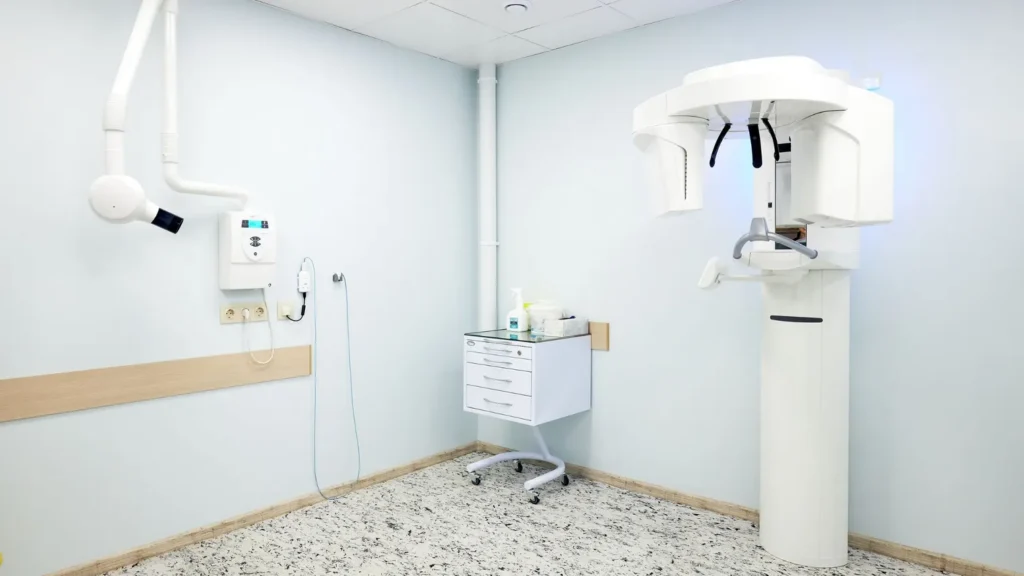
A cone beam CT system uses a cone-shaped X-ray beam while the imaging unit rotates around the head. The data collected during the scan are reconstructed into a three-dimensional digital image that your dentist can review from different perspectives.
Depending on the area being scanned, CBCT may provide information about:
- Teeth and tooth roots
- Jawbone
- Impacted or developing teeth
- Sinuses and nasal structures
- The location of certain nerve pathways
- Bone height, width, and shape
- Relationships between teeth and nearby structures
That extra dimension can be valuable when a clinical exam and conventional X-rays do not provide all the information needed for the case.
When Might a Dentist Recommend CBCT?
The reason for ordering a cone beam scan depends on the patient and the treatment being considered. Common dental uses include implant planning, selected surgical cases, impacted teeth, and complex endodontic questions.
Dental Implant Planning
When planning dental implants, the dentist may need a 3D view of the available bone and nearby anatomy before placement. CBCT can provide measurements and spatial information that are difficult to obtain from a flat image alone.
The scan is only one part of determining whether implant treatment is appropriate. Gum health, medical history, existing teeth, bite, treatment goals, and other clinical factors also matter.
Extractions and Impacted Teeth
For a complex tooth extraction, a cone beam scan may be recommended when the dentist needs a clearer view of root shape or nearby anatomy.
It can also be useful when evaluating certain impacted or developing wisdom teeth, especially when their position in relation to nearby structures could affect treatment planning.
Selected Root Canal Cases
Most root canal evaluations do not automatically require CBCT. A 3D scan may be considered when symptoms persist, anatomy is unusually complex, previous treatment needs to be evaluated, or conventional imaging does not provide enough information.
Your dentist can determine whether CBCT would add useful information before recommending root canal treatment or another approach.
CBCT vs. Traditional Dental X-Rays
Conventional dental X-rays remain appropriate for many routine concerns. Bitewing, periapical, panoramic, and other two-dimensional images can often provide the information needed while using less radiation than a cone beam scan.
CBCT uses ionizing radiation and generally involves more radiation exposure than conventional dental radiographs, although the amount varies with the equipment, settings, and size of the area scanned. For that reason, the decision to use CBCT should be based on whether the added 3D information is clinically justified for that patient.
In other words, CBCT is not inherently better than a standard dental X-ray. Each type of imaging has a different purpose, and your dentist should choose the option that provides the information needed for your care.
What Happens During a Cone Beam Scan?
Depending on the equipment, you will usually sit or stand while your head is positioned in the scanner. The unit rotates around your head while you remain still for the image capture. Some systems use a small positioning or bite support to help keep the head and jaws in the correct position.
The scan itself does not involve drilling, injections, or dental treatment. After the images are created, your dentist can review the area in three dimensions and use that information alongside the clinical examination and other records.
Frequently Asked Questions About CBCT Dental Scans
Is a cone beam scan the same as a regular dental X-ray?
No. Both use X-rays, but conventional dental radiographs are two-dimensional. CBCT collects information from multiple angles and reconstructs it into a 3D view.
Does every dental implant patient need a CBCT scan?
Imaging is selected for the individual case. CBCT is commonly used for presurgical implant planning, but your dentist determines which records are needed based on your anatomy, existing images, and treatment plan.
Does a CBCT scan use radiation?
Yes. CBCT uses ionizing radiation and generally exposes a patient to more radiation than conventional dental X-rays. The amount varies by system and scan settings, so CBCT should be used when the expected clinical benefit justifies the additional imaging.
3D Dental Imaging in Greater Phoenix
If a treatment decision requires information that cannot be obtained adequately from an exam and conventional X-rays, a cone beam scan may provide the additional 3D view your dentist needs. The first step is an evaluation, not scheduling a scan on your own.
Dental Design Studios serves patients at nine offices across Greater Phoenix. Choose a Dental Design Studios location to schedule an evaluation and learn which imaging, if any, is appropriate for your care.